
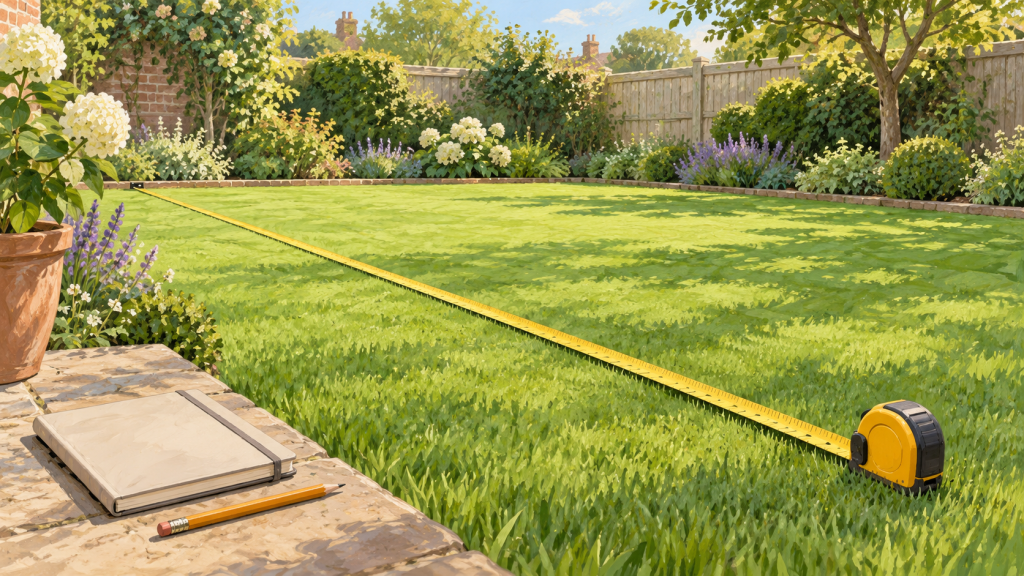
The amount of grass seed you need depends on the size of the area and the sowing rate for the mixture you choose. Measure the lawn in square metres, multiply by the rate on the seed packet, then convert grams to kilograms.
Area in m² × sowing rate in g/m² ÷ 1,000 = seed needed in kg
Use the rate for the job you’re doing. A packet may give different rates for overseeding an existing lawn and sowing a new one. The RHS recommends checking the packet because rates vary between mixtures.
Measure the area you’re sowing
For a rectangular lawn, multiply its length by its width. A lawn measuring 8 metres by 5 metres has an area of 40 square metres.
For an irregular lawn, split it into manageable shapes, work out each area and add them together. If you’re repairing only a few bare patches, measure those patches rather than buying enough seed for the entire lawn.
Calculate the quantity
Imagine a 40 m² lawn and a seed mixture whose packet recommends 25 g/m² for overseeding:
40 m² × 25 g/m² = 1,000 g, or 1 kg of seed.
If the packet for a different job specifies 35 g/m², the same 40 m² would need 1,400 g, or 1.4 kg. These figures show the calculation; use the rate printed for your own mixture and job.
Compare your result with the available pack sizes. If the exact amount isn’t sold, choose enough to cover the measured area at the stated rate. Keep any remainder dry in its original packaging, following the supplier’s storage guidance.
Overseeding or starting a new lawn?
Overseeding adds seed to existing grass; starting a new lawn means sowing a prepared seedbed. Check the rate for the method you’re using on your chosen packet.
If most of the lawn is still healthy and the problem is confined to small patches, a local repair may be enough. If little useful grass remains, assess the cause and the ground before deciding whether to prepare and reseed the whole area.
Does using extra seed give a better result?
Stick to the manufacturer’s guidance. The preparation and conditions matter too: seed needs good contact with the soil, suitable warmth and enough moisture to establish. A thick layer of seed won’t correct compacted ground, deep shade or a surface that dries out repeatedly.
Sow evenly across the prepared area and water gently when needed, without washing seed away. Keep foot traffic off newly sown areas while the grass establishes. See our guide to the first cut of new grass and follow the packet’s aftercare advice.
Questions people ask
How many square metres will 1 kg of grass seed cover?
At a hypothetical rate of 25 g/m², 1 kg covers 40 m². At 35 g/m², it covers about 28.6 m². Your packet’s rate determines the coverage for the job you’re doing.
Should I include paths and flower beds in the measurement?
No. Calculate the area you’re actually sowing. For a lawn with a path through it, subtract the path’s area from the overall measurement.
Can I use the same calculation for fertiliser?
Yes: area multiplied by the product’s application rate gives the total quantity. Use the fertiliser’s own label and units. Seed and fertiliser rates are not interchangeable.