
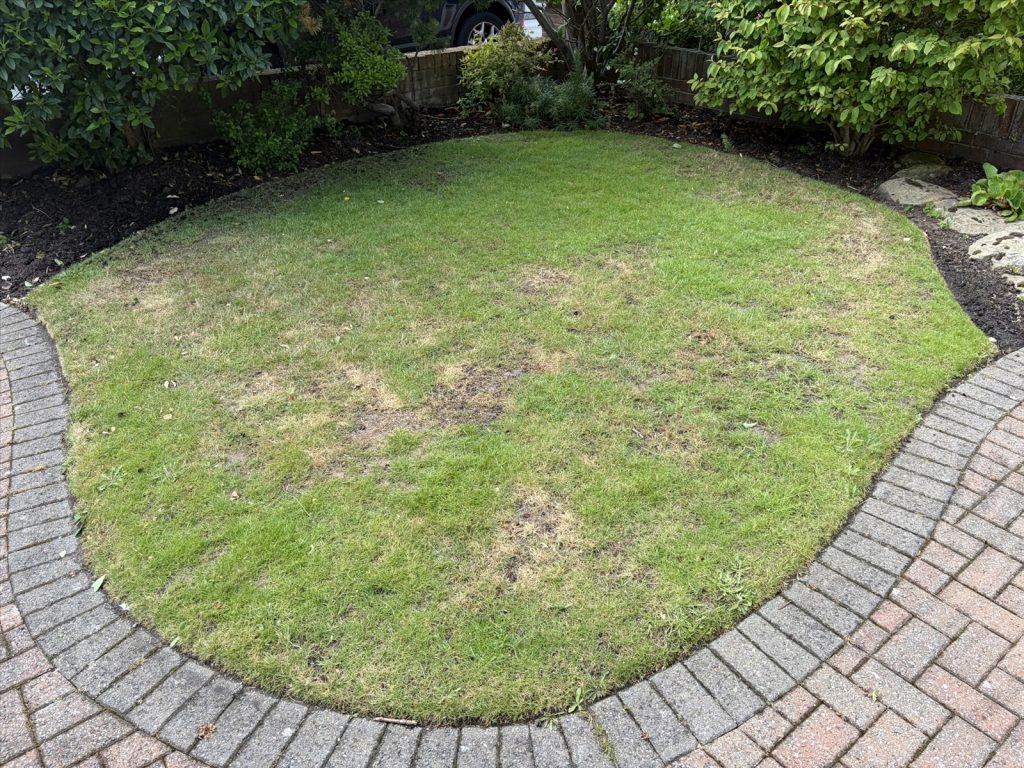
A lawn can become thin because it is worn faster than it recovers, shaded, too wet, dry or repeatedly cut too short. The pattern offers a useful clue: a bare route to a gate suggests wear, while a sparse strip beneath trees may be affected by shade and competition for moisture. Several causes can occur together.
Before sowing or feeding, look at where the grass is thinning and how conditions change across the lawn. That helps you choose a repair suited to the area.
Wear and regular use
If the damage follows a familiar route or appears where children and pets play, reduce traffic while the area recovers. A stepping stone can take pressure off a narrow route. For a larger worn area, a seed mix intended for a frequently used lawn may be appropriate, but seedlings still need protection while they establish.
Shade and tree roots
Notice how long the area gets direct light and whether a fence, hedge or tree casts shade. Tree roots can also compete with grass for moisture. A shade mix may help in light or moderate shade; in deep shade, consider a different ground cover or surface if grass continues to struggle. Our grass seed guide explains how to match a mix to the site.
Ground that stays wet or dries out
If water remains on the lawn long after rain, investigate where it collects and whether the ground is compacted. Keep off saturated areas: walking on them can make surface compaction worse. The RHS waterlogging guide discusses possible causes and ways to improve compacted soil.
During a dry spell, brown grass may recover when conditions improve. Check whether living plants are returning before reseeding. Where the soil is bare, use the seed packet’s directions and plan for gentle watering while seedlings establish.
Moss and surface build-up
Moss often grows where grass struggles, including damp or shaded areas. It can be left in place if you are happy with it; the RHS describes its value for wildlife. If you remove moss or accumulated dead material, do so when the lawn can recover, and repair exposed gaps rather than assuming removal alone will change the conditions.
Mowing and nutrients
On uneven ground, a low mower setting can scalp high spots and expose soil. Raise the cutting height if the lawn is being cut very short, keep the blade sharp and avoid taking off a large amount of growth in one cut.
Weak growth has several possible causes. Feed can be useful where nutrients are needed, but check growing conditions first and follow the product’s rate and timing. Our lawn feeding guide covers when to consider it.
Choose the right repair
For a few bare areas, follow our patch repair guide. If grass remains across most of the lawn but looks sparse, overseeding may be suitable. A badly damaged lawn with very little useful grass or major surface problems may need more extensive renovation.
If you would like help assessing a lawn in Formby or the L37 area, see our local lawn care page.